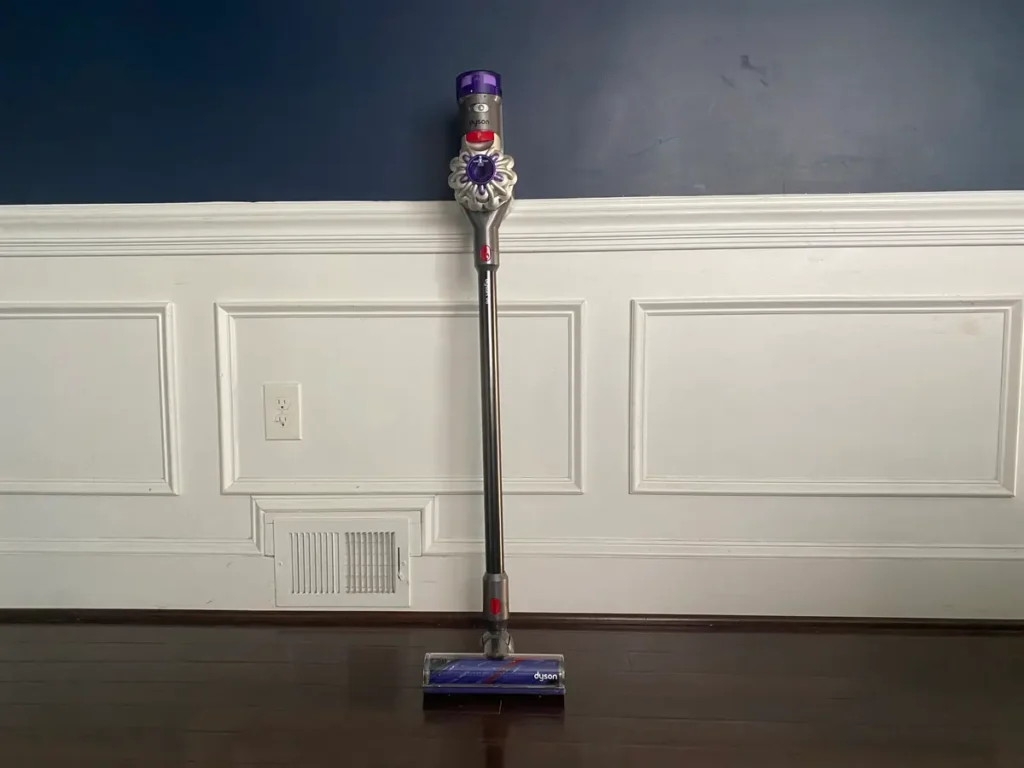

Dyson V8 Review 2025: Is This Classic Cordless Vacuum Still Worth It?
The Dyson V8 has been a cornerstone of the cordless vacuum market for years, often praised for its powerful suction and lightweight design. But in a field of ever-evolving competitors and newer Dyson models, does it still hold its ground? This in-depth Dyson V8 review pulls from extensive user experiences and expert testing to see if this popular model is the right cleaning companion for your home. While the Dyson V8 is celebrated for its ease of use and effective pet hair pickup, potential buyers should be aware of its limitations, particularly concerning battery life and performance on hard floors.
Build Quality
The Dyson V8 features the brand’s signature sturdy, plastic construction, engineered to be lightweight at just 5.6 pounds (2.5 kg) for easy maneuvering
The motor and battery are positioned around the handle to create a favorable center of gravity. However, this Dyson V8 review must note a common concern among long-term users: durability issues. Some users report components, like the red bin-release lever, can break with normal use over time, and the body can develop cracks
While it feels premium initially, its long-term resilience may not meet everyone’s expectations, especially given its premium price point.
Value for Money
When assessing value, the Dyson V8 presents a mixed bag. It is significantly more affordable than newer models like the V15 or Gen5 Detect, often going on sale which increases its value proposition
For its price, you get powerful suction and a versatile set of attachments, including a motorized tool for pet hair. The Dyson V8 is a complete replacement for a corded vacuum for many users in small to medium-sized homes. The main detractor from its value is the battery life; with a runtime of only 40 minutes in standard mode and a steep drop to around 7 minutes in Max mode, it may not suffice for larger homes without frequent recharging.
Ease of Use
This is where the Dyson V8 truly excels and remains a favorite. Its lightweight and ergonomic handle design make it easy to carry up and down stairs and use for above-floor cleaning
The swivel head effortlessly navigates around furniture legs and other obstacles. A standout feature is the ability to empty the dustbin without removing the wand, a convenience lost in some newer Dyson models
The trigger operation conserves battery but can be tiring for those with weaker hands during longer cleaning sessions. Converting to a handheld vacuum is quick and simple, making it versatile for cleaning cars, upholstery, and other tight spaces.
Cleaning & Maintenance
For daily cleaning, the Dyson V8 performs admirably. Its 115 Air Watts of suction power is effective on both carpets and hard floors, picking up fine dust, dirt, and debris with ease
The newer models come with a “detangling Motorbar cleaner head” that actively removes wrapped hair from the brush roll, a huge advantage for pet owners . Maintenance is straightforward: the dustbin uses a hygienic “point and shoot” mechanism, and the washable filters should be cleaned monthly. Be aware that the filters take a full 24 hours to dry, so planning is necessary to avoid downtime.
Noise Level
The Dyson V8 operates at a noise level of approximately 75 dB, which is relatively quiet for a powerful vacuum
It’s quiet enough on standard mode to hold a conversation, but the Max mode is noticeably louder, comparable to traditional corded vacuums. This makes it suitable for use in apartments or homes with sleeping children or noise-sensitive pets, as long as the boost mode is used sparingly.
Battery Life
The battery life is the most significant compromise of the Dyson V8. Dyson rates it at up to 40 minutes of fade-free suction, but this is in standard mode with a non-motorized tool attached
Real-world tests with the motorized floor head often result in runtimes closer to 25-30 minutes . The Max mode drops drastically to an average of just 6-7 minutes, suitable only for quick spot cleans . The non-removable battery takes 5 hours to charge fully, and a common complaint among users is battery degradation after 1-2 years, requiring a costly replacement